4-Week At-Home Workout Plan: Daily Workouts + Stretches
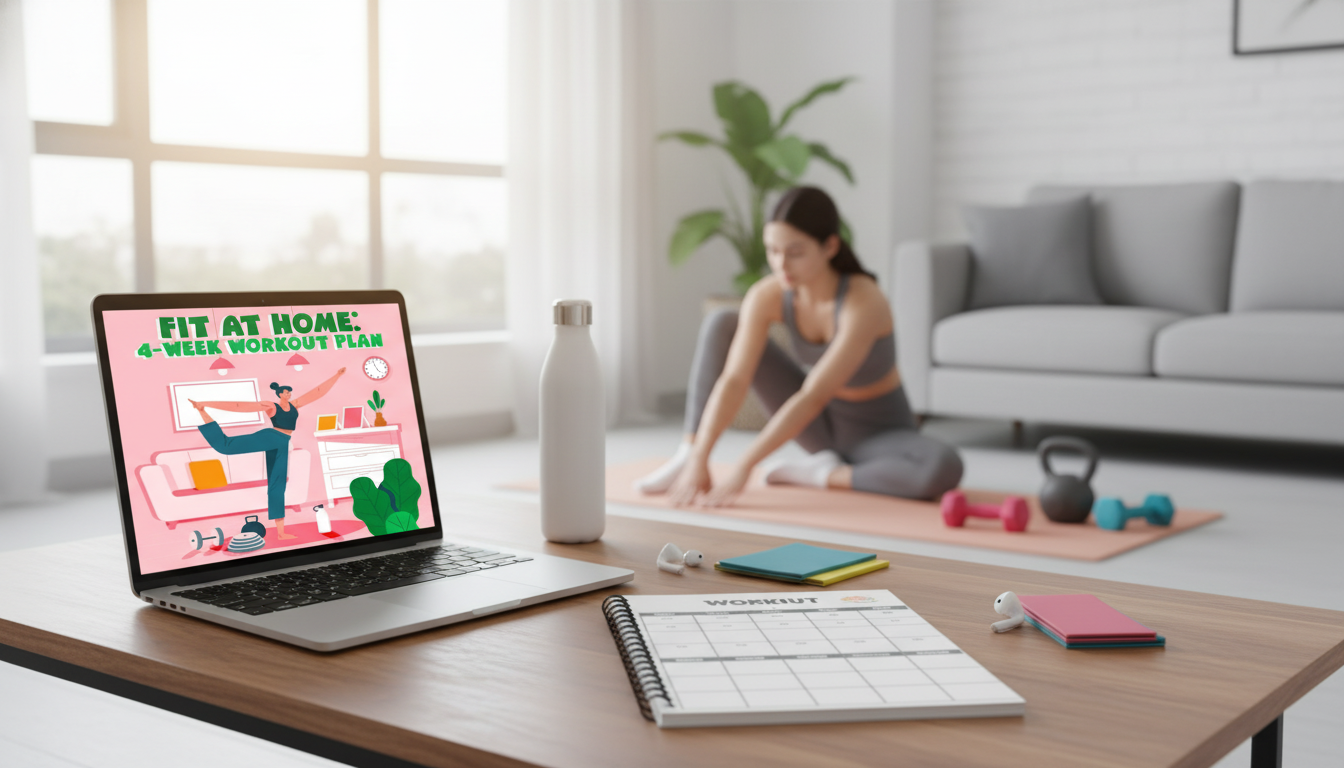
Fit at Home: A 4-Week Plan With Daily Workouts and Stretches (Minimal Equipment)
A structured month-long routine can make home training feel simple and repeatable. This 4-week approach uses short, focused daily sessions, clear progression, and recovery-friendly stretches—built around bodyweight moves and a few optional tools like a resistance band or light dumbbells. Over time, the goal is to do a little more work with better control, while keeping joints and energy levels happy.
If you prefer a ready-to-follow daily checklist, Fit at Home: 4-Week Workout Plan (PDF) with Daily Workouts & Stretches is a printable option that keeps exercise order, rest, and modifications in one place.
What This 4-Week Routine Looks Like
- Daily pattern: warm-up → main workout (strength, cardio, or core) → cool-down stretches.
- Weekly rhythm: 3 strength-focused days, 2 conditioning days, 1 mobility/recovery day, 1 full rest day (adjustable).
- Progression: add reps, reduce rest, increase sets, or choose harder variations each week.
- Session length: typically 20–45 minutes depending on fitness level and time available.
This structure aligns well with widely recommended activity targets (mixing strength and aerobic work). For reference, see the World Health Organization (WHO) physical activity recommendations and the CDC’s overview of physical activity benefits.
Minimal Equipment Setup (And No-Equipment Alternatives)
- No-equipment essentials: a stable chair/bench, a wall, a towel, and enough floor space to lie down safely.
- Optional upgrades: resistance bands, a yoga mat, light-to-moderate dumbbells or a kettlebell.
- Household substitutions: backpack loaded with books for squats/hinges, water jugs for carries, towel “sliders” on smooth floors.
- Safety basics: use a non-slip surface, clear space around hands/feet, and stop sets when form breaks.
If you’re adding resistance work, the American College of Sports Medicine (ACSM) resources are a reliable place to learn general principles like gradual progression and balanced training.
Weekly Schedule at a Glance
- Strength days: lower body + core, upper body + core, full body circuit.
- Conditioning days: low-impact intervals, steady-state brisk walk or step-ups.
- Mobility day: hips, thoracic spine, ankles, shoulders, plus gentle core stability.
- Rest day: optional easy walk and light stretching.
| Day | Focus | Main Work | Stretches (5–10 min) |
|---|---|---|---|
| Day 1 | Lower body + core | Squat pattern, hinge pattern, glute bridge, plank | Hip flexor, hamstrings, calves |
| Day 2 | Conditioning | Intervals: marching/step-ups/shadow boxing (low-impact) | Quads, calves, chest opener |
| Day 3 | Upper body + core | Push-up pattern, row/pull (band/towel), shoulder stability, side plank | Lats, pecs, upper back |
| Day 4 | Mobility/recovery | Controlled mobility flow + breathing | Full-body gentle holds |
| Day 5 | Full body circuit | 3–5 moves in rounds (legs, push, pull, core, carry) | Glutes, hips, thoracic rotation |
| Day 6 | Conditioning (steady) | 20–40 min walk or step-up ladder | Hip flexor, calves, hamstrings |
| Day 7 | Rest | Optional easy walk | Relaxed full-body stretch |
How to Progress Each Week (Without Overthinking It)
- Week 1: learn the movement patterns; keep 2–3 reps “in reserve” on most sets.
- Week 2: add 1 set to key exercises or add 2–4 reps per set.
- Week 3: keep sets; shorten rest by 10–20 seconds or use a harder variation.
- Week 4: maintain intensity while improving control, tempo, and range of motion; deload if fatigue is high.
- Simple rule: increase only one variable at a time (reps OR sets OR rest OR difficulty).
A practical way to track progression is to write down just three items: the variation used, total reps completed, and the rest time. If your form stays crisp, progress; if it gets shaky, hold steady for a session and “earn” the next increase.
Daily Stretching: What to Do After Each Session
- Choose 4–6 stretches total; hold each 20–45 seconds and breathe slowly.
- After lower body: hip flexor stretch, hamstring stretch, calf stretch, glute stretch.
- After upper body: chest doorway stretch, lat stretch, upper-back stretch, neck gentle side bend.
- Add mobility on tight areas: ankle rocks, thoracic rotations, shoulder circles.
- Avoid forcing end range; aim for mild tension, not pain or numbness.
Keep the cool-down calm. If your breathing can return to a slow, nose-breath rhythm while you stretch, you’re in the right intensity zone for recovery.
Common Form Cues for Safer Home Training
- Squat/hinge: keep ribs stacked over pelvis; move at hips and knees with control.
- Push-ups: keep body in a straight line; hands under shoulders; slow lower phase.
- Rows/pulls (band/towel): pull elbows toward ribs; avoid shrugging shoulders.
- Core work: brace as if preparing for a gentle cough; avoid lower-back arching.
- Stop a set if: sharp pain, dizziness, loss of balance, or technique collapse.
Helpful “home-gym” tip: film one set from the side. You’ll quickly see if your plank is sagging, your squat is shifting, or your shoulders are creeping up during rows.
Printable Plan Option for Simple Day-by-Day Tracking
For a streamlined tracker you can reuse, Fit at Home: 4-Week Workout Plan | Minimal Equipment Exercise Guide PDF pairs daily workouts with stretches so you’re not piecing things together mid-session.
If you want to support the routine with a quick mindset check-in (sleep, stress, motivation, soreness notes), Mindful Clarity: Journal & Prompts (Printable) can make your weekly review more consistent—especially during weeks 3–4 when fatigue tends to creep up.
FAQ
How can I workout at home without equipment?
Use bodyweight basics like squats, lunges, hip hinges, push-ups (incline if needed), and planks, then add low-impact conditioning such as marching, step-ups, or shadow boxing. Progress by increasing reps, adding sets, slowing tempo, reducing rest, or moving to a harder variation; a chair, wall, towel, or loaded backpack can add challenge without “gym” gear.










Leave a comment